Urban Living Library: A Biodiversity-led Framework for Campus Regeneration
Fengyi Wu · London - United Kingdom
Citation Winner 2026
Overview
Cities face an unprecedented biodiversity crisis driven by habitat fragmentation, climate change, and increasing urbanisation. While universities occupy significant areas of open space, many institutional campuses remain disconnected from wider ecological networks and function primarily as ornamental landscapes rather than productive ecological systems.
Urban Living Library proposes a new landscape framework that transforms university campuses into interconnected ecological infrastructure capable of supporting biodiversity, environmental education, and climate resilience simultaneously. Developed for the University of London, the project demonstrates how landscape architecture can reposition ecology as the organising principle of institutional design while creating healthier environments for both wildlife and people.
The proposal uses the decline of the native hedgehog as an indicator of broader ecological fragmentation across the United Kingdom. Rather than designing exclusively for one species, the project establishes a layered network of habitats that supports birds, pollinating insects, mammals, amphibians, and soil organisms while improving the quality of everyday public space.
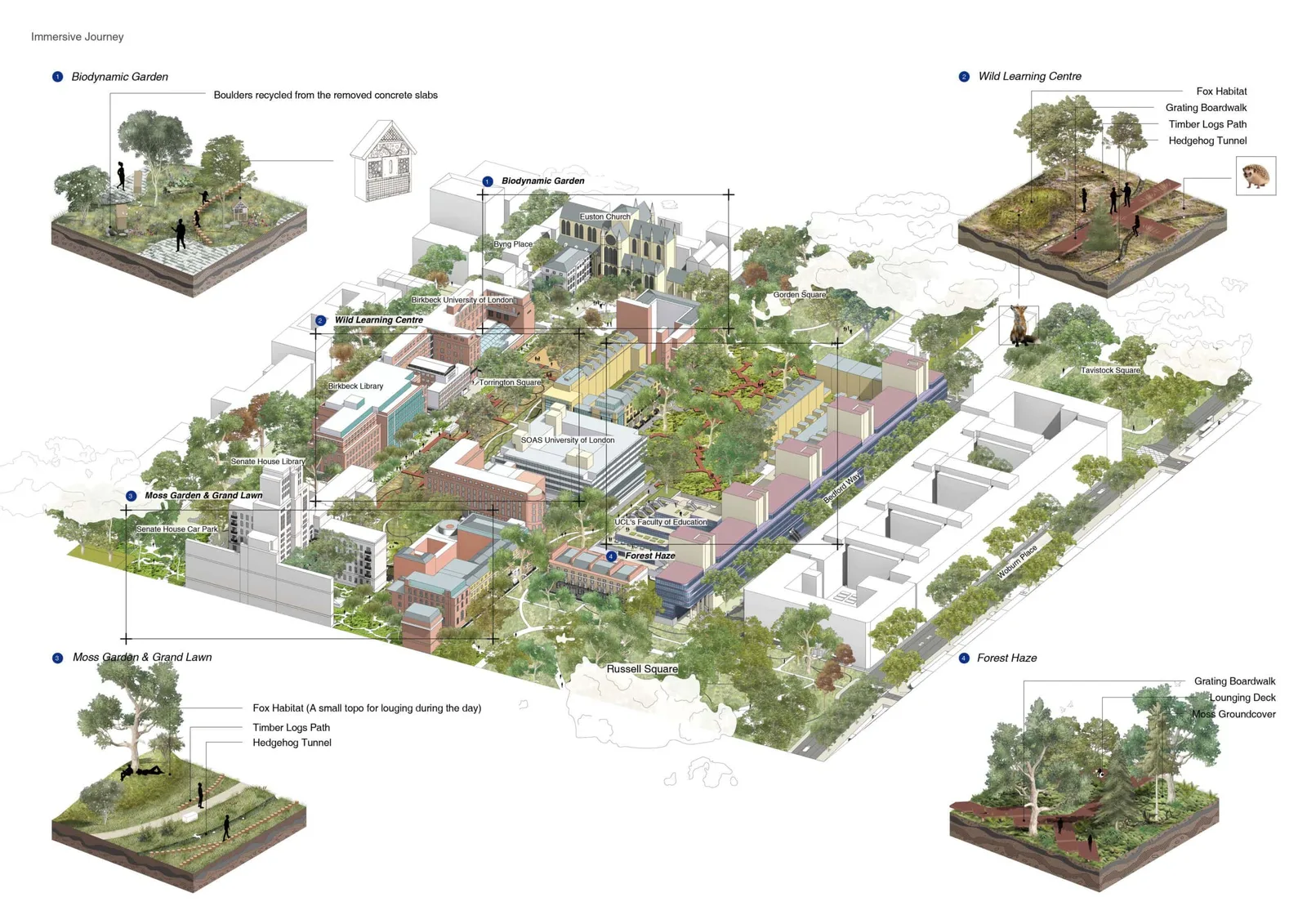
The masterplan reconnects fragmented open spaces through a continuous ecological corridor integrating woodland, heathland, moss gardens, biodynamic planting, wildflower meadows, and adaptive landscape typologies. These habitats are carefully distributed across the campus to maximise ecological connectivity while preserving accessibility and strengthening relationships between buildings, public spaces, and existing vegetation.
At the centre of the proposal is the concept of the Living Outdoor Library, where landscape becomes an active educational resource rather than a passive setting. Outdoor classrooms, biodiversity observation spaces, sensory planting, and ecological stewardship programmes enable students, researchers, staff, and visitors to engage directly with natural systems through everyday experience. Learning is therefore embedded within the landscape itself.
Unlike conventional campus masterplans that prioritise circulation and visual amenity, Urban Living Library integrates ecological performance into every spatial intervention. Wildlife movement, planting succession, water management, microclimate improvement, and biodiversity enhancement collectively inform the organisation of the campus. Each landscape element performs multiple ecological and social functions, demonstrating the potential of multifunctional green infrastructure within dense urban environments.
Although developed for a specific site, the project proposes a scalable methodology that can be adapted by higher education institutions internationally. Universities collectively occupy extensive urban landscapes that possess significant yet underutilised ecological potential. By retrofitting existing campuses rather than replacing them, institutions can contribute meaningfully to biodiversity recovery while enhancing environmental education and public wellbeing.
Recognised with First Prize in the IFLA Student & Young Professionals Awards, Urban Living Library illustrates how landscape architecture can move beyond site-specific design to establish a replicable model for biodiversity-led campus regeneration. It demonstrates that ecological infrastructure can become an integral part of institutional life, positioning universities not only as centres of knowledge but also as active participants in restoring the environmental systems upon which cities depend.
- Studio
- Fengyi Wu
- Website
- issuu.com/chloe-wu-003020
- Location
- London - United Kingdom
- Edition
- 2026
- Discipline
- Landscape Design
- Category
- Urban Design
Project credits
- Lead Designer
- Fengyi Wu
- Team
- Fengyi Wu
- Consultants
- Fengyi Wu
- Photography
- Fengyi Wu