ANEMONE 2190
Weimar Design · Taipei - Taiwan
New Talent Award 2026
Category Winner 2026
Overview
ANEMONE 2190 is a speculative furniture collection that asks how the materials of our industrial present might be perceived as craft in the future. Comprising two seating systems and one pendant lamp, the project reimagines the relationship between people, objects, and space through the morphology and interdependence of marine life. Together, the three pieces form a single domestic ecosystem: soft, vivid, and inviting at first encounter, yet carrying a darker story about petrochemical culture and the oceans it has transformed.
Craft objects often begin as ordinary tools. As their original functions recede with time, their proportions, surfaces, and traces of making become newly visible. Bamboo, wood, ceramics, metal, glass, and textiles are valued today not only as useful materials, but as vessels of accumulated knowledge. Their beauty is inseparable from generations of cutting, weaving, firing, joining, and repair. ANEMONE 2190 extends this idea through a speculative question: a century from now, could plastic foam and industrial metal become the bamboo and wood of another era?
PE and EVA foam are currently understood as standardized, inexpensive industrial materials, and often as symbols of environmental damage. Instead of disguising that contradiction, the collection makes it central. Foam is woven, folded, layered, bundled, and shaped by hand around metal frameworks. These slow, repetitive processes resist industrial uniformity. Small variations, irregular densities, and visible accumulations record the maker’s decisions, giving anonymous materials tactility, warmth, and individual character. The work proposes not that petrochemical materials are innocent, but that material meaning changes through time, labor, scarcity, and memory.
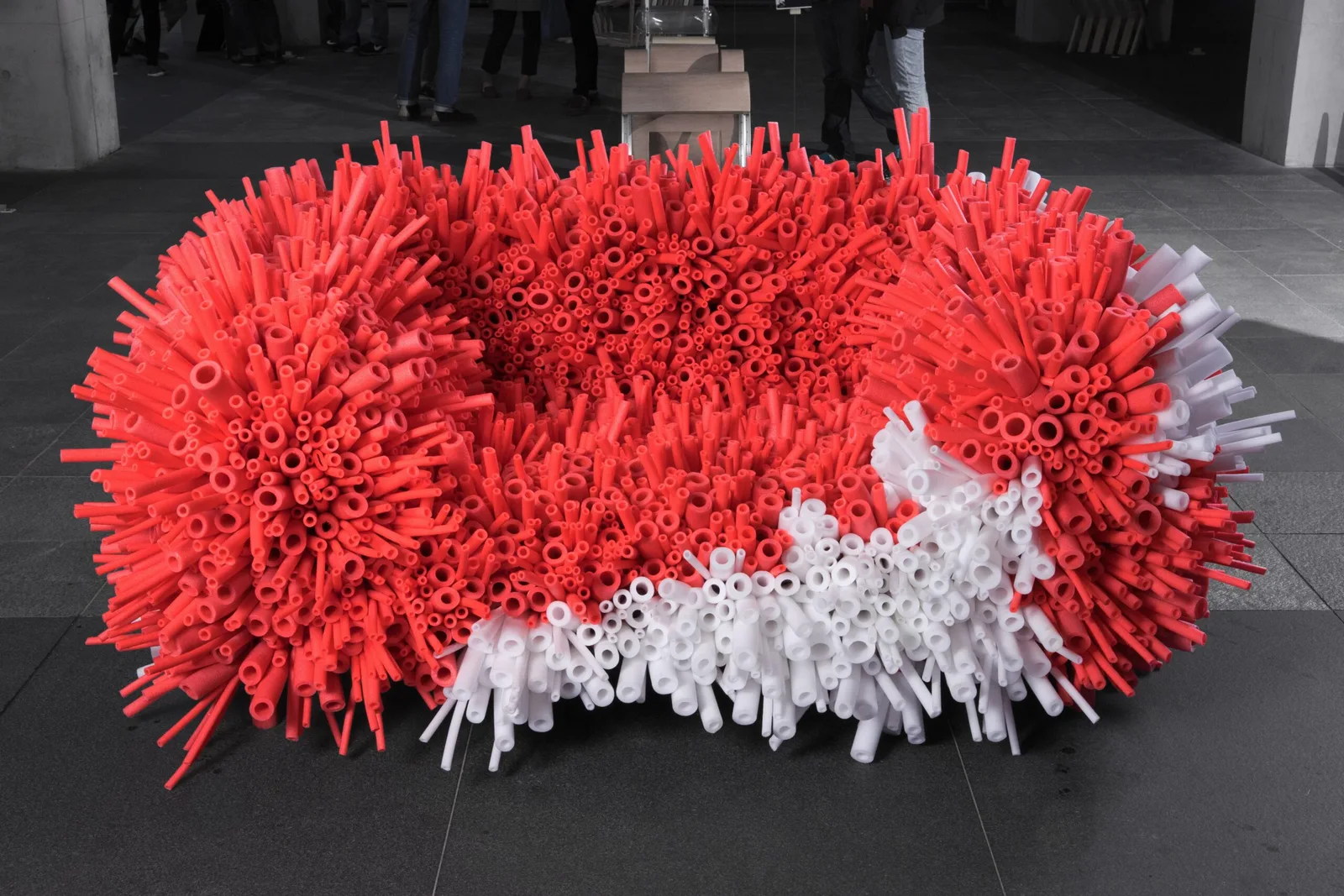
The first piece, the origin of the collection, is a sculptural sofa made from thousands of brightly colored PE foam tubes supported by a metal structure. Their clustered ends evoke the tentacles of a sea anemone, while their softness creates an enveloping surface that responds to the body. The sitter does not simply occupy the sofa; pressure, movement, and touch temporarily reshape its field of flexible tubes. This active exchange transforms sitting into an encounter with a responsive organism.
The second piece develops that encounter into a modular seating landscape. Constructed from hand-folded and layered EVA foam sheets over metal components, each unit can connect repeatedly, allowing the sofa to extend without a predetermined endpoint. Like coral colonies or organisms living through mutual association, individual modules remain distinct while forming a larger habitat. Its configuration can adapt to different rooms, group sizes, and social situations, encouraging users to negotiate distance, orientation, and shared space. The layered loops cradle the body while giving the surface a rhythmic, almost botanical movement.
The pendant lamp translates the same material language into light. Strips of EVA foam are looped and interwoven around a metal armature, producing a dense, spherical body whose saturated colors appear to pulse across its surface. Light filters through the gaps between the loops, softening the boundary between object and atmosphere. Where the seats receive physical pressure, the lamp shapes perception through shadow, glow, and color; it completes the collection by extending tactility beyond touch.
Although the collection moves across furniture and lighting, it is conceived as one furniture concept rather than three unrelated products. Each object tests the same proposition at a different scale: the individual body, the social group, and the surrounding atmosphere. Repetition provides both construction logic and identity. Tubes become tentacles; folded sheets become polyps; loops become a porous shade. Metal supplies a skeleton, while foam forms the living interface. Together, rigid support and yielding skin stage a dialogue between industry and organism.
The sea anemone is both formal inspiration and ethical warning. Petrochemical products have contributed profoundly to marine pollution, and continued consumption may leave future generations with synthetic relics but fewer living organisms to remember. Reconstructing an anemone from materials that endanger its habitat creates deliberate irony: the imitation may outlast the life it represents. The foam’s brilliant pigments will also fade gradually with exposure and time, echoing bleaching, loss of vitality, and ecological disappearance. Aging is therefore not treated as failure, but as part of the narrative carried by the work.
In high-pressure urban life, the collection offers a gentle counterenvironment. Its softness, buoyant colors, organic density, and playful responsiveness introduce the calm associated with underwater worlds into rigid architectural space. Yet comfort is never separated from unease. ANEMONE 2190 operates simultaneously as furniture, imagined future craft, and material forecast. By transforming mass-produced foam through handwork, the project asks what society chooses to preserve, what it allows to vanish, and how tomorrow’s objects might reveal the values and consequences of today.
- Studio
- Weimar Design
- Location
- Taipei - Taiwan
- Edition
- 2026
- Discipline
- Concept Design
- Category
- Furniture Concept
Project credits
- Lead Designer
- Elizabeth Y. Lee
- Photography
- Chih Liang Chen
Gallery
08 imagesRecognised by LOOP
2026
New Talent Award
Concept Design
Furniture Concept
2026
Category Winner
Concept Design
Furniture Concept