Ibis Red New Concept
AO · São Paulo - Brazil
Category Winner 2026
Overview
Ibis Red New Concept is a global hospitality concept developed by AO for Accor through an international competition that invited five architecture and design studios to rethink the future of the brand. The proposal investigates how economy hospitality can move beyond standardized neutrality without compromising efficiency, affordability or global scalability.
The project begins with a central question: how can a global hotel brand create spaces that remain recognizable while still generating a genuine sense of identity and connection? AO responds through the idea of authenticity, understood not as an aesthetic style, but as coherence between use, materiality, perception and operation. Rather than reproducing the same atmosphere everywhere, the concept establishes a flexible system capable of maintaining a consistent identity while adapting to different contexts.
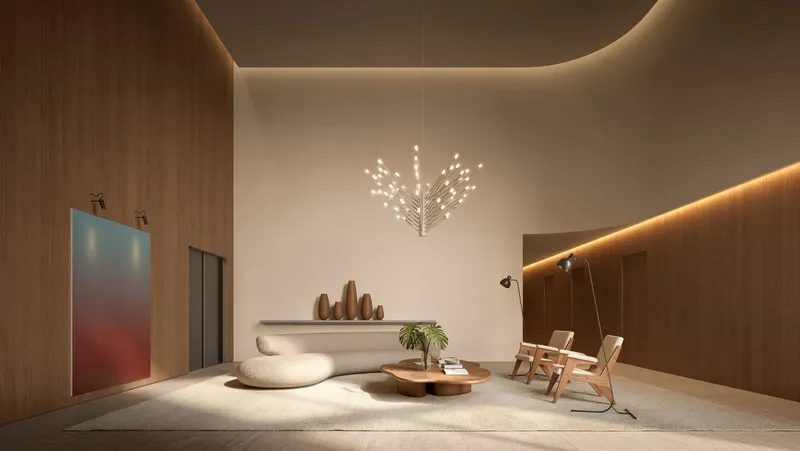
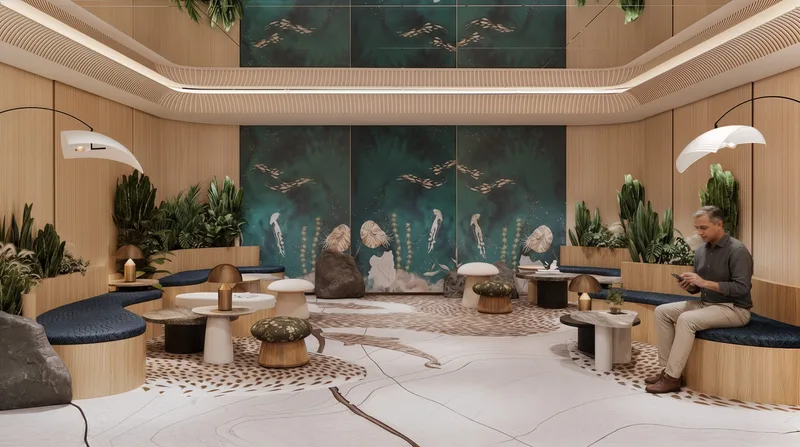
Phenomenology informs the design approach, placing lived experience at the center of the project. Space is conceived as a sequence of atmospheres shaped by scale, light, texture, sound and materiality. These transitions guide guests from more active and collective environments toward increasingly private and introspective spaces, transforming circulation itself into part of the hospitality experience.
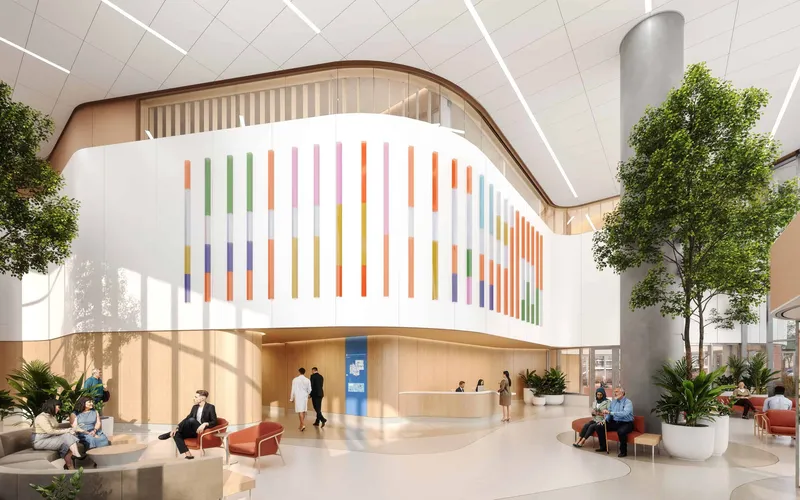
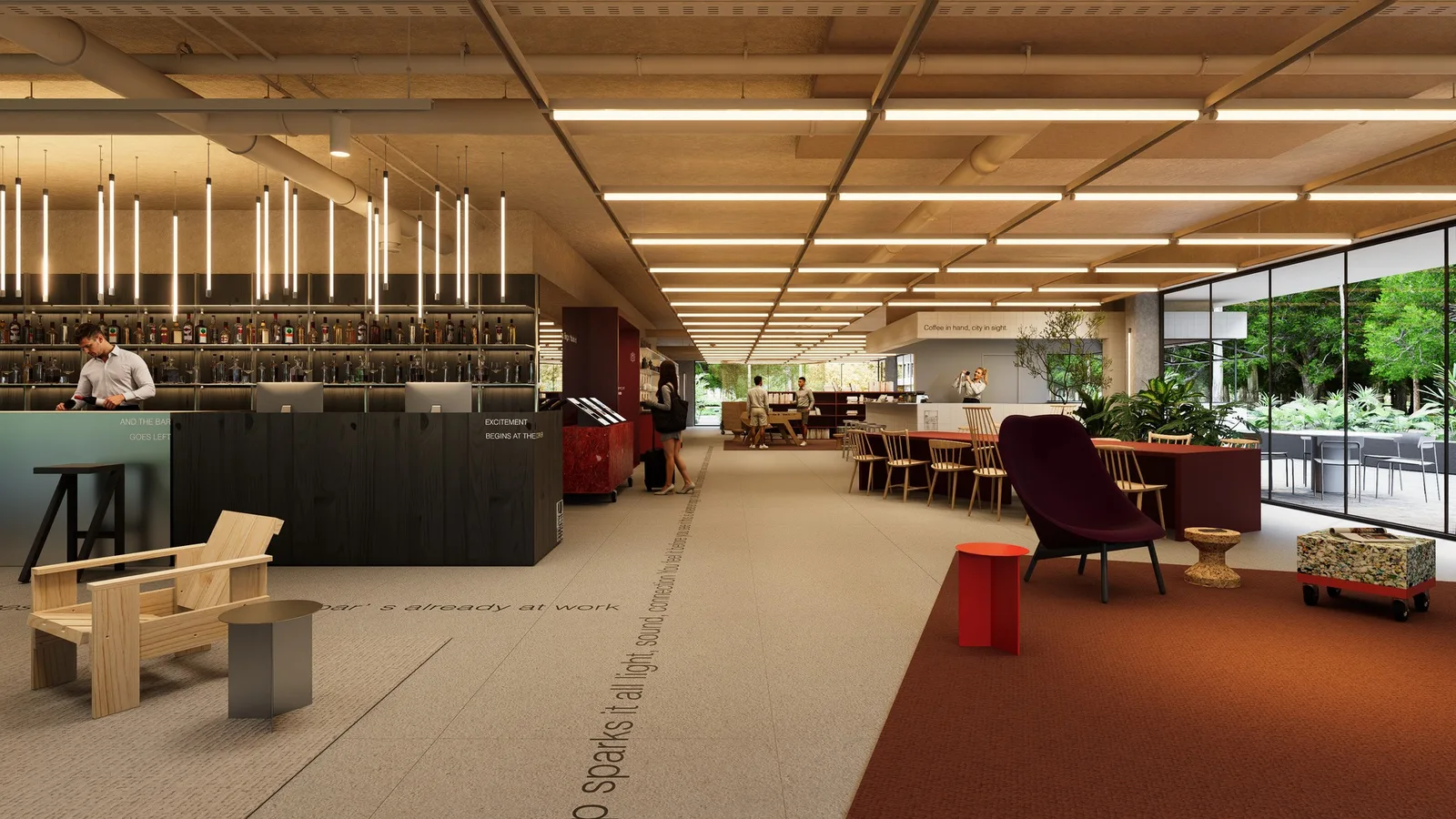
On the ground floor, the traditional hotel core is reinterpreted as an active spatial device. Instead of concentrating functions within an opaque central volume, the core is fragmented into distinct programmatic “boxes” that reveal and organize the hotel’s operation. This strategy increases spatial legibility, allowing guests to intuitively understand how the environment works and how to move through it.
Programs are conceived as hybrid and adaptable rather than fixed. The bar and check-in are combined within a single element that can accommodate different patterns of use throughout the day. An open kitchen exposes processes usually hidden from guests, bringing operation into the spatial experience and creating closer relationships between guests, staff and food preparation. By reducing physical and functional barriers, the ground floor becomes a flexible social environment that supports work, gathering, eating and informal interaction.
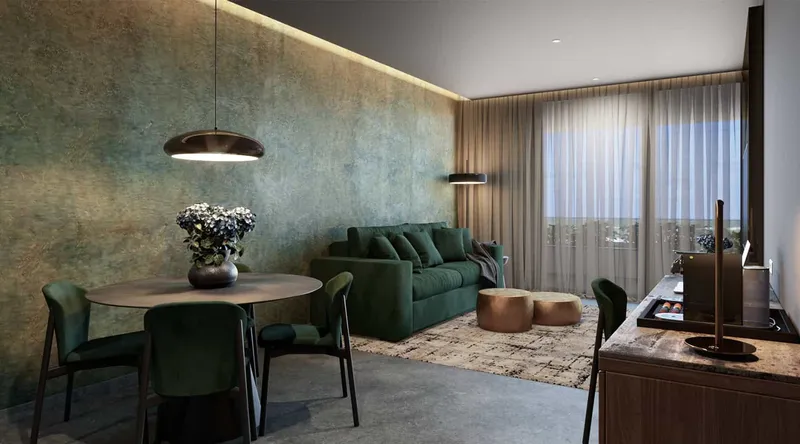
On the upper floors, corridors become more than transitional spaces. Variations in color, texture and sensory intensity gradually shift the atmosphere from collective activity toward rest and privacy. Guest rooms follow a principle of maximum efficiency with minimum complexity. A compact bathroom volume concentrates infrastructure, while integrated and multifunctional furniture accommodates different uses within a rational and adaptable system.
Materiality is one of the project’s main investigative tools. AO developed a methodology for evaluating materials according to both sensorial and sustainability criteria, considering qualities such as touch, texture, opacity, temperature and acoustics alongside carbon emissions, renewability, recyclability, durability, maintenance and origin. Sustainability therefore becomes inseparable from the sensory experience rather than an additional layer applied to the design.
This research supports a palette of accessible, durable and expressive materials whose intrinsic qualities are intentionally revealed. Replicable elements, modular furniture and rationalized lighting systems reinforce operational efficiency while allowing the concept to adapt across different locations.
By interweaving spatial experience, operation and material responsibility, Ibis Red New Concept transforms the constraints of economy hospitality into design drivers. Rather than proposing a fixed image to be repeated globally, it establishes a flexible framework in which efficiency and identity can coexist, creating a hospitality model that is simultaneously sensorial, sustainable and authentic.
- Studio
- AO
- Website
- architectsoffice.co
- Location
- São Paulo - Brazil
- Edition
- 2026
- Discipline
- Concept Design
- Category
- Interior Design Concept
Project credits
- Lead Designer
- Greg Bousquet
- Team
- Cássio Riman, Luiza Bouças, Ariel Szlafsztein, Sarah Jimenez, Marcelo Fava, Natan Tako, Nina Luders, Guilherme Carneiro, Eduardo Serpa, Corentin Morel, Marina Mermelstein, Marcelo Chechia
- Photography
- N/A - Concept Project